Most buyers closing on a home in Duck already expect the North Carolina excise tax that shows up on the settlement statement. The Town of Duck says it is a one-time charge of one dollar for every hundred dollars of the sale price, collected by Dare County and set aside for things like courts, libraries, and water and sewer projects. That part is standard across the state and rarely surprises anyone.
What surprises people is the tax bill that arrives the following year. Because in Duck, the annual property tax isn't one number. It's built from a town-wide rate plus an additional charge that depends on which side of a specific line your parcel sits on, a line that has nothing to do with school zones or flood maps and everything to do with sand.
The Line That Splits One Town Into Two Tax Zones
Duck funds its beach nourishment work through two Municipal Service Districts, known locally as MSD-A and MSD-B. These aren't symbolic labels. They're separate taxing boundaries layered on top of the regular town rate, and the money collected from each is dedicated solely to beach nourishment debt, not general operations, not police or public works.
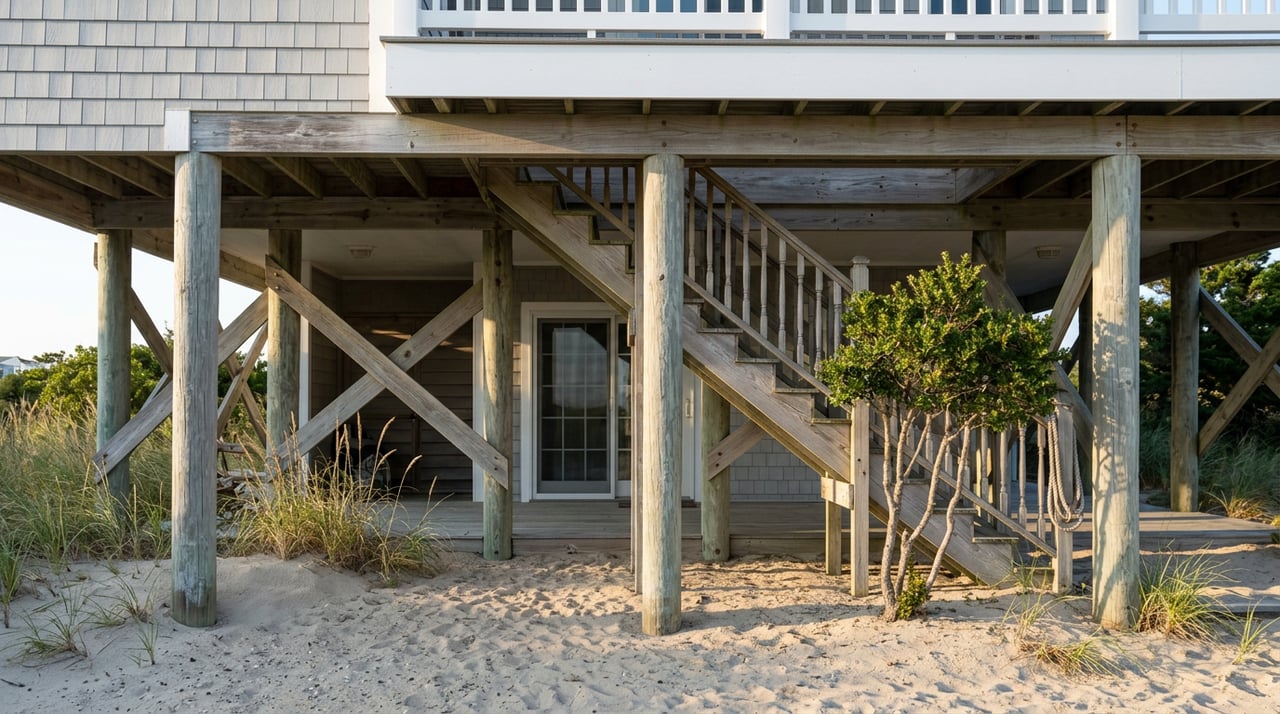
MSD-A covers the entire nourishment project area, which is most of the town. MSD-B sits inside that boundary and applies only to oceanfront parcels. The logic mirrors what several northern Outer Banks towns have adopted over the past decade: everyone in the project area pays something toward a wider beach, but the properties sitting directly on it, the ones whose rental income and structural safety depend most on that sand staying in place, pay an additional rate on top. Southern Shores went through the same debate publicly in 2021, when its council held a hearing on creating comparable districts for a $14.7 million project pumping more than 848,000 cubic yards of sand across 3.7 miles of beach. The mechanics aren't unique to Duck. But the specific rates, and what they mean for a buyer's math, are.
A lower tax rate and a lower tax bill are not the same claim, even though they're printed on the same line of the same document.
What The Two Districts Actually Charge
Here's where the numbers matter, and where the shift over the past few years tells a more interesting story than the headline rate suggests.
| District | Coverage | FY2020-21 Rate | FY2025-26 Rate |
|---|---|---|---|
| MSD-A | Full nourishment project area | $0.1296 per $100 | $0.0798 per $100 |
| MSD-B | Oceanfront parcels only | $0.2850 per $100 | $0.1890 per $100 |
On paper, that looks like a win for property owners. The MSD-A rate dropped by roughly 38 percent over five years, and MSD-B fell by about a third. If you're comparing rate sheets side by side, Duck looks like it got cheaper to own a home in.
Why The Rate Fell While The Bill Might Not
The town's own budget language is direct about what happened here: these are described as revenue-neutral rates, meaning they were set to collect roughly the same total dollars as before, not less.
The reason the rate could drop while the revenue stayed flat is Dare County's revaluation cycle. The county reassesses property values on a set schedule, and Duck's most recent revaluation, completed in 2025, added approximately $1.2 billion to the town's overall tax base. An earlier revaluation cycle had already added over $202 million, a 12.5 percent jump, in a prior fiscal year. Each time assessed values climb that sharply, the town can lower its per-hundred-dollar rate and still bring in the same amount of money, because that rate is now being applied to a much larger pool of assessed value.
This matters for anyone comparing what they'd owe today against what a seller says they paid two or three years ago. If your specific parcel's assessed value rose in line with the 2025 revaluation, and most did given the scale of that adjustment, a lower MSD rate applied to a higher assessment can land you at a similar dollar figure, or higher, than what the previous owner paid under the old rate. The rate cut is real. Whether it translates into savings depends entirely on how much your particular property's assessed value moved, which is a parcel-level question, not a townwide one.
There's also a forward-looking piece worth flagging. The town's most recent nourishment work was completed in spring 2023, and the modeling behind the FY2025-26 budget showed no need to raise MSD rates to cover that debt. Duck's fiscal year runs July through June, so that budget closed at the end of June 2026, and the town has since moved into a new fiscal year under its usual process. Duck's next nourishment cycle is expected in 2027, and any new debt issued for that project would get folded into whatever rate the town sets going forward. The rate a buyer sees quoted today should always be confirmed against the town's current budget, not assumed from a prior year's figure, however recent.
The Same Program, Funded Twice Over
Property owners inside the MSD boundaries aren't the only ones paying into Duck's beach program. About 17.7 percent of the town's general sales tax revenue is also restricted to beach nourishment projects, which means every dollar spent at a shop, restaurant, or rental booking in Duck contributes something to the same fund, regardless of who owns the parcel. For an investor evaluating a vacation rental purchase, this is a useful data point: the nourishment program that protects the beach your renters come for is partly funded by the same visitor spending that generates your rental income, not solely by an annual bill tied to your deed.
Before You Write an Offer in Duck
A buyer's agent who knows to check these things before contract can save you from an unpleasant surprise at your first tax bill.
- Confirm which MSD, if any, applies to the specific parcel, not just the general area. Oceanfront and non-oceanfront homes a few streets apart can carry different combined rates.
- Ask the listing agent or seller for the property's actual prior-year tax bill, not just the posted rate, so you can see the dollar effect of the current assessed value.
- Factor in the standard Dare County excise tax at closing, one dollar per hundred of the sale price, as a separate, one-time cost from the annual MSD assessment.
- Ask whether the seller has any documentation of how their bill changed across the last revaluation cycle. It's a fair question, and a well-prepared seller should have an answer ready.
- If you're planning to hold the property past 2027, ask your agent to flag any public discussion of the town's next nourishment financing plan as it develops.
What Sellers Should Be Ready To Explain
If you're preparing to list in Duck, the MSD question is one buyers are increasingly likely to raise, especially those coming from markets without this kind of layered municipal financing. Being able to show exactly which district your home falls in, what your last two or three tax bills actually totaled, and how that compares to the posted rate removes a point of friction before it becomes a point of hesitation. It's a small piece of preparation that signals you understand your own numbers, which buyers notice.
FAQ
Does every property in Duck pay an MSD tax? Every parcel inside the nourishment project boundary pays the MSD-A rate. Oceanfront parcels also pay the additional MSD-B rate on top of it. Properties outside the project area entirely would not carry either charge, which is another reason to confirm your specific parcel rather than assume based on the general town rate.
Will rates rise again after the 2027 nourishment cycle? The modeling behind Duck's FY2025-26 budget showed no need to raise MSD rates for the debt tied to the 2023 project. Any new debt issued for the 2027 cycle would be a separate calculation, and since that FY2025-26 budget has now closed, the rate for the current fiscal year is worth confirming directly with the town rather than assuming it carried over unchanged.
Where can I check which MSD a specific address falls into? The Town of Duck maintains a map of the MSD district boundaries alongside its published tax rates, which is the most direct way to confirm a parcel's status before writing an offer.
Understanding a tax line before it shows up on your bill is part of buying or selling with confidence in Duck, and it's the kind of detail worth getting right the first time. If you're weighing a purchase or a sale here and want someone who tracks these mechanics closely, Melissa Morgan is glad to walk through the specifics with you. Let's Connect.
This article is general information, not legal, tax or financial advice. Consult a qualified professional about your situation.